
Trying to conceive can lead many women to explore supplements that may support reproductive health. One supplement that has received increasing attention is coenzyme Q10 (CoQ10), an antioxidant that plays an important role in cellular energy production.
Research suggests that CoQ10 for fertility may offer potential benefits for egg quality and ovarian function, particularly in certain women undergoing fertility treatment. However, the evidence is still developing, and taking CoQ10 does not guarantee pregnancy.
In this guide, we explain how CoQ10 works, its potential benefits for female fertility, what research tells us about dosage, and what to consider before taking it.
What Is CoQ10?
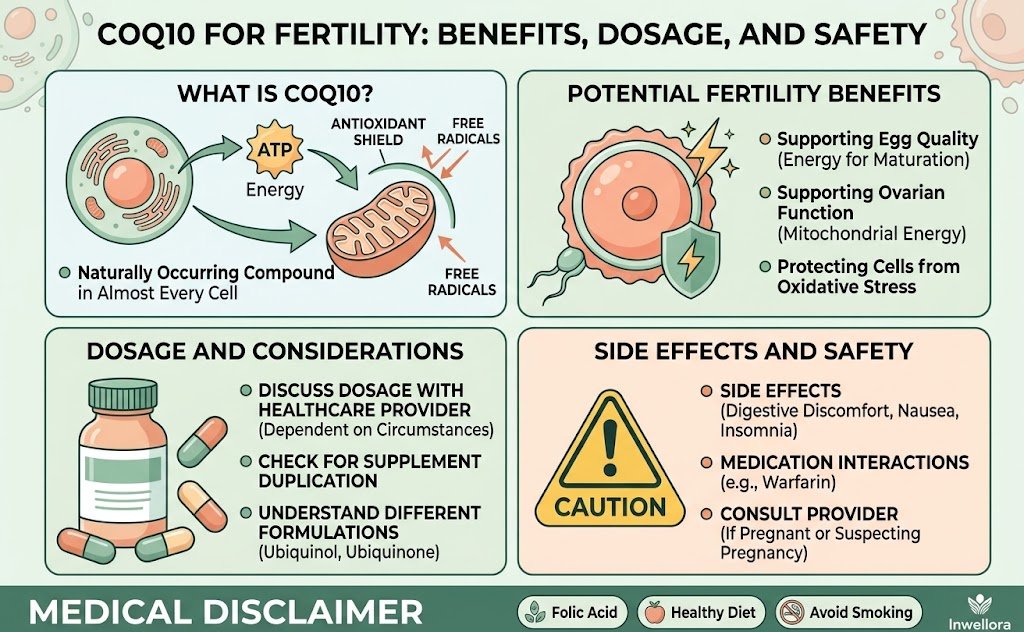
Coenzyme Q10, commonly known as CoQ10, is a naturally occurring compound found in almost every cell in the body. It helps mitochondria produce adenosine triphosphate (ATP), the main energy source used by cells.
CoQ10 also acts as an antioxidant, helping protect cells from oxidative stress caused by unstable molecules called free radicals.
Because egg cells require energy for maturation, fertilization, and early embryo development, researchers have investigated whether CoQ10 supplementation could support reproductive function.
Natural CoQ10 levels may change with age, making this nutrient particularly interesting in research involving ovarian aging and fertility treatments.
How Does CoQ10 Affect Female Fertility?
CoQ10 may influence fertility through two main mechanisms: supporting cellular energy production and helping protect cells from oxidative stress.
- Supporting Egg Quality
Egg cells need adequate energy to mature and complete the processes involved in fertilization and early embryo development.
Mitochondria provide much of this energy. Researchers have therefore studied whether CoQ10 supplementation could support mitochondrial function and improve certain measures of egg quality.
Some clinical studies have reported improvements in laboratory markers, such as the number of retrieved eggs or embryo-related outcomes, in selected groups of women. However, these findings do not establish that CoQ10 reliably improves natural conception or live birth rates.
- Supporting Ovarian Function
Ovarian function can change with age and diminished ovarian reserve. CoQ10 has been investigated as a possible supportive supplement because of its role in mitochondrial energy production.
Some research suggests potential benefits for women with diminished ovarian reserve or those preparing for assisted reproductive treatments.
Nevertheless, CoQ10 has not been proven to restore ovarian reserve or reverse age-related fertility changes.
- Helping Protect Cells From Oxidative Stress
Oxidative stress occurs when the production of free radicals exceeds the body’s antioxidant defenses.
Excessive oxidative stress may affect reproductive cells and the environment in which fertilization and early embryo development occur.
As an antioxidant, CoQ10 may help maintain cellular balance. However, the extent to which supplementation improves meaningful fertility outcomes in humans remains uncertain.
What Does the Research Say About CoQ10 for Fertility?
Research into CoQ10 and female fertility is promising but not conclusive.
A 2025 umbrella review of research on nutrient supplements for female infertility found that CoQ10 might improve clinical pregnancy rates in some assisted-reproduction settings. However, the certainty of this evidence was very low, and the review did not establish a reliable improvement in live birth rates.
This distinction matters because becoming pregnant and having a live birth are different outcomes.
The available evidence does not support recommending CoQ10 to every woman who is trying to conceive. Its potential role may depend on factors such as age, ovarian reserve, medical history, and whether fertility treatment is planned.
Women experiencing difficulty conceiving should discuss evidence-based fertility evaluation and treatment options with a qualified healthcare professional rather than relying on supplements alone.
CoQ10 Dosage for Fertility: How Much Should You Take?
There is no universally established CoQ10 dosage for improving female fertility.
Clinical studies have used different doses, formulations, and treatment durations, so their results cannot be translated into one standard recommendation for everyone.
Before taking CoQ10, consider the following:
- Discuss the dose with your healthcare provider. The appropriate amount depends on your circumstances and the reason for supplementation.
- Allow time for professional assessment. Some fertility studies have examined supplementation for several weeks or months before treatment, but this does not establish an ideal duration for everyone.
- Check your other supplements. Some fertility formulas already contain CoQ10, which may lead to unnecessary duplication.
- Do not delay fertility evaluation. A supplement should not replace an assessment of ovulation, ovarian reserve when indicated, fallopian tube factors, or sperm health.
CoQ10 is available in different formulations, including ubiquinone and ubiquinol. There is insufficient evidence to establish that one formulation consistently produces better fertility outcomes than the other.
When Should You Start Taking CoQ10 for Fertility?
Some studies have investigated CoQ10 supplementation before assisted reproductive treatments, allowing time for potential effects on reproductive-cell processes.
However, there is no established starting date that guarantees improved egg quality or pregnancy.
If you are planning IVF or another fertility treatment, ask your fertility specialist whether CoQ10 is appropriate for your treatment plan and when it should be started or stopped.
If you are trying to conceive naturally, remember that supplement use should be individualized and should not postpone medical advice when conception is taking longer than expected.
CoQ10 Side Effects and Safety
CoQ10 is generally well tolerated by many adults, but side effects can occur.
Possible side effects include:
- Digestive discomfort or an upset stomach
- Nausea
- Insomnia in some people
CoQ10 can also interact with certain medicines, including warfarin, and may be unsuitable alongside some treatments. Tell your healthcare provider about all medicines and supplements you use.
If you are pregnant, suspect you may be pregnant, or are undergoing fertility treatment, consult your healthcare provider before continuing or starting CoQ10. Safety information during pregnancy is limited.
Natural Ways to Support Egg Quality and Fertility
No single food or supplement can guarantee better egg quality. However, several evidence-based steps can support general reproductive health.
Follow a Balanced Diet
Eat a varied diet that includes vegetables, fruit, whole grains, legumes, nuts, healthy fats, and adequate protein. Choose foods that help meet your nutritional needs rather than relying on a single fertility food.
Take Folic Acid Before Pregnancy
Folic acid is recommended for people planning pregnancy because it helps reduce the risk of neural tube defects. In the United States, the general recommendation for those who could become pregnant is 400 micrograms daily, unless a healthcare professional recommends a different dose.
Folic acid supports early fetal development; it should not be presented as a treatment for infertility.
Avoid Smoking
Smoking is associated with adverse reproductive outcomes. Avoiding tobacco and secondhand smoke is an important part of preconception health.
Address Underlying Health Conditions
Conditions affecting ovulation, thyroid function, metabolic health, or reproductive organs may influence fertility. Appropriate assessment and treatment can be more important than adding another supplement.
Seek Fertility Advice When Needed
If you are under 35 and have been trying to conceive for 12 months without success, a fertility evaluation is generally recommended. If you are 35 or older, seek evaluation after six months. Earlier assessment may be appropriate when you have irregular periods or a known reproductive condition.
Frequently Asked Questions
Does CoQ10 improve egg quality?
Some studies suggest that CoQ10 may improve certain egg- or embryo-related measures in selected women, particularly in assisted reproduction. However, evidence is limited, and a consistent improvement in live birth rates has not been established.
Can CoQ10 help you get pregnant naturally?
It is not yet clear whether CoQ10 meaningfully increases natural conception rates. Research findings from fertility-treatment settings cannot automatically be applied to women trying to conceive naturally.
How long does CoQ10 take to work for fertility?
There is no proven timeline. Some studies have evaluated supplementation over several weeks or months, but no duration guarantees an improvement in fertility.
Is CoQ10 safe while trying to conceive?
Many adults tolerate CoQ10 well, but safety depends on individual health, medications, and treatment plans. Consult your healthcare provider, particularly if you are receiving fertility treatment or could already be pregnant.
Is CoQ10 better than other fertility supplements?
There is insufficient high-quality evidence to conclude that CoQ10 is superior to other fertility supplements. The most appropriate approach depends on your individual needs and the cause of any fertility difficulties.

Puritan’s Pride Coenzyme CoQ10 400mg
Dietary Supplement for Heart Health, Blood Pressure, Oral Gum Health, and Healthy Aging Support, Rapid Release Softgels
As an Amazon Associate I earn from qualifying purchases.
CoQ10 for fertility is an area of active research because of its role in cellular energy production and antioxidant protection. It may offer benefits for certain women, particularly in assisted reproductive settings, but the current evidence is not strong enough to promise improved pregnancy or live birth rates.
If you are considering CoQ10, discuss its potential benefits, dose, and safety with your healthcare provider. A personalized fertility plan, appropriate medical evaluation, and good preconception care remain the foundations of reproductive health.