
Trying to conceive can be challenging, especially when irregular ovulation or hormonal imbalances make it harder to predict your fertile window. If you’ve been researching fertility supplements, you’ve probably come across myo-inositol.
Myo-inositol is a naturally occurring compound that plays an important role in insulin signaling and cellular communication. It has gained attention as a potential supplement for women with polycystic ovary syndrome (PCOS), particularly because of its possible effects on metabolic health, menstrual regularity, and ovulation.
But does myo-inositol actually improve fertility? Can it help you ovulate regularly? And what is the recommended dosage?
In this guide, we’ll explore the potential benefits of myo-inositol for fertility, what scientific research says, commonly studied doses, and important safety considerations.
What Is Myo-Inositol?
Myo-inositol is one of the naturally occurring forms of inositol, a vitamin-like compound sometimes referred to as vitamin B8, although it is not officially classified as a vitamin.
It is found naturally in foods such as fruits, beans, grains, nuts, and vegetables. The body can also produce it.
Myo-inositol helps regulate several cellular processes, including insulin signaling. This is particularly relevant to reproductive health because insulin plays an important role in ovarian function and hormone regulation.
Myo-inositol is especially popular among women with PCOS, a hormonal condition that can affect ovulation, menstrual cycles, and fertility.
Myo-Inositol Benefits for Fertility: What Does Research Suggest?
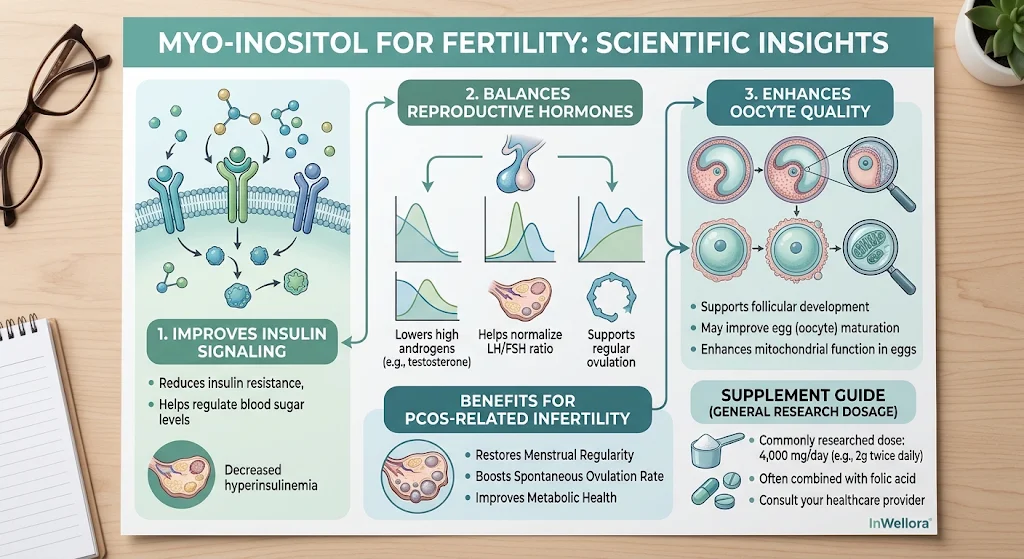
Myo-inositol has been studied mainly in women with PCOS. Some studies suggest potential reproductive and metabolic benefits, although the overall evidence remains limited.
Here are the most commonly discussed benefits.
- May Support Healthy Ovulation
One of the main reasons women use myo-inositol when trying to conceive is its potential role in supporting ovulatory function.
Women with PCOS may experience irregular or absent ovulation due to hormonal and metabolic disturbances.
Because myo-inositol participates in insulin signaling, researchers have investigated whether supplementation may help improve the hormonal environment involved in ovarian function.
Some clinical studies suggest that inositol supplementation may support menstrual regularity and ovulation in certain women with PCOS.
However, the evidence is not strong enough to establish myo-inositol as a proven ovulation treatment.
- May Improve Insulin Sensitivity in Women With PCOS
Insulin resistance is common in PCOS, although not every woman with PCOS has it.
When the body becomes less responsive to insulin, it may produce more insulin to maintain normal blood glucose levels.
Higher insulin levels can stimulate ovarian androgen production, potentially contributing to hormonal disturbances and irregular ovulation.
Myo-inositol has been investigated for its potential insulin-sensitizing effects.
Some research suggests improvements in certain metabolic markers, including insulin-related measures. However, results vary between studies, and the benefits are not consistently demonstrated.
- May Support Menstrual Regularity
Irregular menstrual cycles are common among women with PCOS, often because ovulation does not occur regularly.
Some clinical studies have reported improvements in menstrual regularity following inositol supplementation.
This may be particularly relevant for women who experience long menstrual cycles or unpredictable periods.
However, myo-inositol should not be considered a guaranteed way to regulate menstrual cycles. Persistent irregular periods require medical evaluation to identify the underlying cause.
- May Support Ovarian Function
Myo-inositol is involved in cellular signaling pathways that play a role in ovarian function.
Researchers have explored its potential effects on follicular development and oocyte (egg) maturation, particularly in women undergoing assisted reproductive treatments.
Some studies suggest possible improvements in certain ovarian response parameters.
However, evidence that myo-inositol improves egg quality or increases the likelihood of a successful pregnancy remains insufficient.
It is important to distinguish improvements in laboratory or hormonal markers from meaningful fertility outcomes, such as clinical pregnancy and live birth.
- May Have a Role in Assisted Reproductive Treatment
Myo-inositol has also been investigated in women undergoing IVF and other assisted reproductive procedures.
Some research suggests it may influence ovarian stimulation requirements or certain laboratory outcomes.
However, current evidence does not establish that taking myo-inositol increases clinical pregnancy or live birth rates.
Women undergoing fertility treatment should discuss any supplements with their fertility specialist before starting them.
Myo-Inositol Dosage for Fertility: How Much Should You Take?
One of the most common questions is how much myo-inositol women should take when trying to conceive.
There is no universally established fertility dosage.
Many clinical studies involving women with PCOS have investigated doses around 2,000 mg twice daily (4,000 mg per day), sometimes combined with folic acid.
Other studies have used different doses and formulations.
A commonly marketed formulation combines myo-inositol and D-chiro-inositol in a 40:1 ratio. However, this ratio has not been established as the optimal formulation by high-quality evidence or international guidelines.
The 2023 International Evidence-Based Guideline for PCOS states that current evidence is insufficient to recommend a specific type, dose, or combination of inositol.
Therefore, the dose should be discussed with a healthcare professional based on your diagnosis, reproductive goals, and overall health.
Important: The 4,000 mg daily dose is a commonly studied research dose, not a universally recommended prescription for every woman trying to conceive.

Life Extension Inositol Caps
Supports Mood Health, Well-Being, Healthy Metabolism & Hormone Balance, Gluten-Free, Non-GMO & Vegetarian
✓ increase fertility and treat PCOS
As an Amazon Associate I earn from qualifying purchases.
How Long Does Myo-Inositol Take to Work?
There is no established timeline for when myo-inositol starts improving reproductive or metabolic outcomes.
Some studies have evaluated supplementation over approximately 8–12 weeks or longer.
However, this does not mean every woman will notice changes within this period.
Potential responses may depend on factors such as:
- Whether you have PCOS.
- Your metabolic and hormonal profile.
- Whether you experience irregular ovulation.
- The supplement formulation and dose.
- Other underlying fertility factors.
If you are taking myo-inositol, your healthcare provider can help determine whether continued use is appropriate and whether your menstrual or metabolic markers are changing.
Myo-Inositol Side Effects and Safety
Myo-inositol is generally considered well tolerated in studies, but it may cause some side effects.
Possible side effects include:
- Mild nausea.
- Bloating.
- Diarrhea.
- Abdominal discomfort.
- Headache or dizziness in some individuals.
The available evidence on long-term safety, particularly during pregnancy, remains limited.
If you are pregnant, undergoing fertility treatment, taking medication for blood sugar regulation, or managing a chronic medical condition, consult your healthcare professional before using myo-inositol.
Also, remember that dietary supplements can differ in quality, purity, and actual ingredient content. Choose products from reputable manufacturers with appropriate quality testing.
Who May Benefit Most From Myo-Inositol?
Myo-inositol has been studied primarily in women with PCOS.
It may be worth discussing with a healthcare professional if you:
- Have been diagnosed with PCOS.
- Experience irregular menstrual cycles associated with PCOS.
- Have metabolic concerns associated with PCOS.
- Are exploring complementary approaches to reproductive health.
However, myo-inositol is not a fertility treatment for every woman.
If you have unexplained infertility, diminished ovarian reserve, blocked fallopian tubes, male-factor infertility, or other reproductive conditions, taking myo-inositol alone is unlikely to address the underlying problem.
Can You Take Myo-Inositol Without Having PCOS?
Myo-inositol is sometimes marketed as a general fertility supplement for women without PCOS.
However, most of the available reproductive research has focused on women with PCOS or those undergoing assisted reproductive treatment.
There is currently insufficient evidence to recommend routine myo-inositol supplementation for improving fertility in otherwise healthy women without PCOS.
If your menstrual cycles are regular and you ovulate normally, there is no established evidence that taking myo-inositol will increase your chances of getting pregnant.
Does Myo-Inositol Really Help You Get Pregnant?
The short answer is: possibly in certain situations, but it has not been proven to increase pregnancy rates.
Myo-inositol may have some metabolic benefits in women with PCOS and could potentially support aspects of reproductive function.
However, improvements in insulin-related markers or menstrual regularity do not necessarily translate into higher pregnancy or live birth rates.
The 2023 International Evidence-Based PCOS Guideline considers inositol an experimental fertility therapy in women with PCOS-related infertility because the evidence regarding ovulation, clinical pregnancy, and live birth remains uncertain.
For women with PCOS who are struggling to conceive, evidence-based fertility treatments should be discussed with a reproductive specialist.
Frequently Asked Questions
- What is the best myo-inositol dosage for fertility?
A dose of 2,000 mg twice daily has been commonly studied in women with PCOS. However, there is no officially established optimal fertility dose, and international guidelines do not recommend a specific dose.
- Can myo-inositol help regulate periods?
Some studies suggest that inositol may improve menstrual regularity in women with PCOS. However, the results are inconsistent, and it is not guaranteed to regulate periods.
- Does myo-inositol improve egg quality?
Myo-inositol has been investigated for its potential effects on ovarian function and egg maturation. However, there is not enough strong clinical evidence to confirm that it improves egg quality or increases live birth rates.
- Can I take myo-inositol with folic acid?
Some clinical studies have combined myo-inositol with folic acid. Women trying to conceive should still follow standard preconception recommendations for folic acid and discuss combined supplements with their healthcare provider.
- Should I take myo-inositol if I don’t have PCOS?
There is insufficient evidence to recommend myo-inositol routinely for improving fertility in women without PCOS. Whether it is appropriate depends on your individual circumstances.
- Is myo-inositol better than metformin for PCOS?
They are not interchangeable treatments. Metformin has a more established role in managing certain metabolic features of PCOS, while evidence for inositol remains limited. Your healthcare provider can help determine which approach is appropriate.
Final Thoughts
Myo-inositol is an interesting supplement in reproductive health research, particularly for women with PCOS.
It may offer some metabolic benefits and could support menstrual regularity in certain women. However, current research does not establish it as a proven fertility treatment or confirm that it increases pregnancy and live birth rates.
If you are trying to conceive, focus on identifying the underlying cause of any ovulation or fertility problems rather than relying on supplements alone.
A personalized approach that includes appropriate medical evaluation, evidence-based treatment, and healthy lifestyle habits remains the best way to support your reproductive health.
⸻