
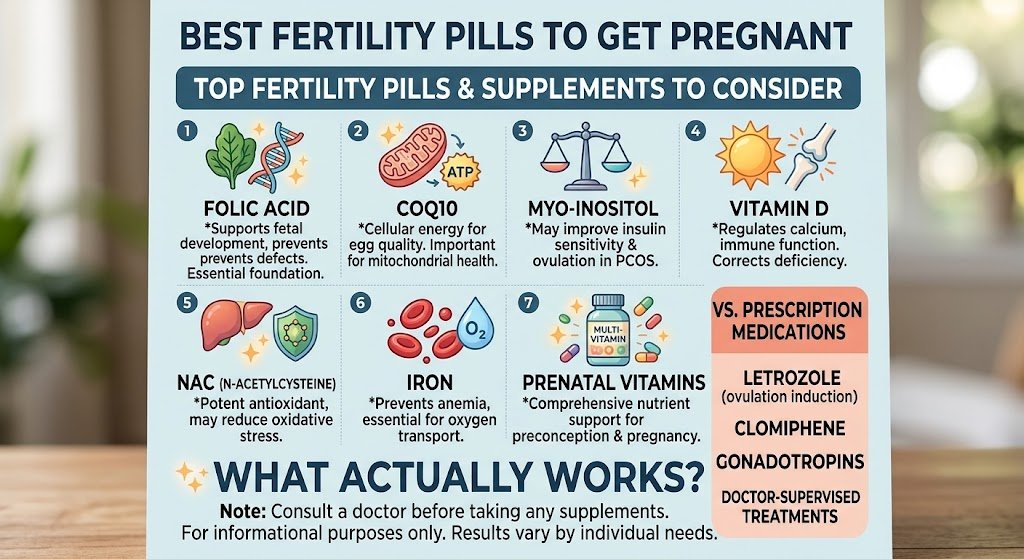
Trying to get pregnant can be an emotional journey, especially when conception takes longer than expected. Many women start looking for the best fertility pills to get pregnant, hoping that certain vitamins or supplements can improve their chances of conceiving.
But do fertility pills really work?
The truth is that some supplements may support reproductive health, particularly when a woman has a nutritional deficiency or a specific hormonal condition. However, no over-the-counter fertility supplement has been proven to reliably increase the chances of natural conception in every woman.
In this guide, we’ll explore seven commonly used fertility supplements, their potential benefits, what scientific research says about them, and when medical treatment may be more appropriate.
Can Fertility Pills Help You Get Pregnant?
Fertility pills and supplements are often marketed as products that improve ovulation, egg quality, and hormone balance. However, their effectiveness depends on the underlying cause of fertility problems.
For example:
- Women with nutritional deficiencies may benefit from correcting those deficiencies.
- Women with polycystic ovary syndrome (PCOS) may benefit from certain supplements, although evidence varies.
- Women with ovulation disorders may need prescription medications rather than ordinary vitamins.
- Women with blocked fallopian tubes or significant male-factor infertility will not resolve these problems by taking fertility supplements.
It’s important to distinguish between fertility supplements and prescription fertility medications. They are not interchangeable.
7 Best Fertility Pills and Supplements to Consider
Here are seven supplements commonly discussed in relation to female fertility. Their potential benefits and limitations are different, and not all are appropriate for every woman.
- Folic Acid
Folic acid is one of the most important supplements for women planning pregnancy.
Although it is not a fertility drug and does not directly stimulate ovulation, it plays an essential role in early fetal development.
Potential benefits:
- Supports healthy DNA synthesis and cell division.
- Helps prevent neural tube defects in developing babies.
- Provides an important nutritional foundation before conception.
Recommended dosage:
Most women planning pregnancy should take 400 mcg of folic acid daily, starting at least one month before conception and continuing through the first 12 weeks of pregnancy.
Some women need a higher dose depending on their medical history and risk factors, so they should follow their healthcare provider’s advice.
Is it worth taking?
Yes. Folic acid is strongly recommended before pregnancy, even though its primary proven benefit is preventing neural tube defects rather than increasing fertility.
CoQ10 is an antioxidant naturally produced by the body. It plays an important role in cellular energy production and helps protect cells from oxidative stress.
Because egg cells require substantial energy during maturation, CoQ10 has attracted attention as a possible supplement for reproductive health.
Potential benefits:
- Supports mitochondrial energy production.
- Helps protect cells against oxidative stress.
- May support certain reproductive outcomes, particularly in women undergoing fertility treatment.
What does the research say?
Some studies suggest that CoQ10 may improve certain fertility outcomes, particularly in women with diminished ovarian reserve or those undergoing assisted reproductive treatment.
However, evidence that it improves natural conception or live birth rates remains insufficient.
Is it worth taking?
CoQ10 may be worth discussing with a fertility specialist, especially for women undergoing fertility treatment. It should not be considered a proven fertility solution.
- Myo-Inositol
Myo-inositol is a naturally occurring compound involved in insulin signaling and several cellular processes.
It is particularly popular among women with PCOS because insulin resistance and hormonal disturbances can interfere with normal ovulation.
Potential benefits:
- May support insulin sensitivity.
- May help regulate certain hormonal and metabolic abnormalities in women with PCOS.
- May improve some ovulation-related outcomes in selected women.
What does the research say?
Myo-inositol has been studied extensively in women with PCOS. Some studies suggest potential improvements in metabolic markers and ovulatory function.
However, evidence regarding improved pregnancy and live birth rates remains uncertain.
The 2023 international PCOS guideline also highlights that evidence is limited and that inositol should not replace established fertility treatment.
Is it worth taking?
It may be an option to discuss with a healthcare provider if you have PCOS, particularly when ovulatory or metabolic problems are present.
It is not necessary for every woman trying to conceive.

Wholesome Story Myo-Inositol & D-Chiro Inositol Supplement for Women
Myo & D-Chiro-Inositol, naturally found in plant foods, work together to help support healthy hormone levels* and encourage a regular, balanced monthly cycle
✓ best supplement
As an Amazon Associate I earn from qualifying purchases.
Vitamin D is important for bone health, immune function, and several reproductive processes.
Vitamin D receptors are present in reproductive tissues, which has led researchers to investigate its possible relationship with female fertility.
Potential benefits:
- Supports normal calcium and phosphate metabolism.
- Helps maintain healthy immune function.
- Correcting vitamin D deficiency supports overall health.
What does the research say?
Some studies have found associations between vitamin D status and reproductive outcomes. However, it is not clear whether supplementation improves natural conception rates.
A recent umbrella review found that the evidence supporting vitamin D supplementation as a fertility treatment remains uncertain.
Is it worth taking?
Women with confirmed vitamin D deficiency should discuss appropriate supplementation with their healthcare provider.
Taking high doses without testing or medical advice is not recommended.
- N-Acetylcysteine (NAC)
N-acetylcysteine, commonly known as NAC, is an antioxidant and a precursor of glutathione, one of the body’s important natural antioxidants.
It has been investigated for its potential role in reproductive health, particularly in women with PCOS.
Potential benefits:
- Supports glutathione production.
- Helps reduce oxidative stress.
- May influence insulin-related metabolic processes.
- Has been studied for possible effects on ovulation in women with PCOS.
What does the research say?
Some clinical studies suggest that NAC may have potential benefits in women with PCOS, but the available evidence is not strong enough to establish it as a reliable fertility treatment.
Is it worth taking?
NAC may be considered in selected situations under medical supervision, but it should not be routinely recommended to every woman trying to conceive.
Iron is essential for hemoglobin production and oxygen transport throughout the body.
Low iron stores and iron deficiency anemia are important health concerns for women of reproductive age, particularly those experiencing heavy menstrual bleeding.
Potential benefits:
- Helps prevent and correct iron deficiency.
- Supports normal red blood cell production.
- Helps maintain healthy oxygen delivery to tissues.
What does the research say?
Some observational research has suggested a relationship between iron intake and ovulatory fertility. However, this does not establish that taking additional iron improves pregnancy rates in women who already have adequate iron stores.
Is it worth taking?
Iron supplementation is appropriate when iron deficiency or increased nutritional requirements are identified.
Ideally, supplementation should be guided by blood tests such as a complete blood count and ferritin.
Taking extra iron without a clear indication may cause gastrointestinal side effects and is not a proven way to improve fertility.
- Prenatal Vitamins
Prenatal vitamins are designed to support nutritional needs before and during pregnancy.
They commonly contain folic acid, iron, iodine, vitamin D, and other essential nutrients.
Potential benefits:
- Help prevent nutritional deficiencies.
- Provide folic acid before early pregnancy.
- Support nutritional requirements during pregnancy.
- Help prepare the body for the increased nutritional demands of pregnancy.
What should you look for?
When choosing a prenatal vitamin, check the label for:
- At least 400 mcg of folic acid for most women planning pregnancy.
- Iron, according to individual nutritional needs.
- Vitamin D.
- Iodine, when appropriate.
- Vitamin B12 and other essential nutrients.
Avoid products containing excessive amounts of preformed vitamin A (retinol), as high intake can be harmful during pregnancy.
Is it worth taking?
Yes. A suitable prenatal vitamin is a practical way to support nutritional preparation for pregnancy. However, it should not be marketed as a medication that increases fertility or guarantees conception.
Comparison: Which Fertility Supplement Is Right for You?
| Supplement | Main purpose | Evidence for improving fertility |
|---|---|---|
| Folic acid | Early fetal development | Strong for preventing neural tube defects, not a proven fertility booster |
| CoQ10 | Cellular energy and antioxidant support | Limited and uncertain |
| Myo-inositol | Metabolic and hormonal support, especially in PCOS | Limited and uncertain |
| Vitamin D | Correcting deficiency | Uncertain for fertility outcomes |
| NAC | Antioxidant support | Limited and uncertain |
| Iron | Correcting iron deficiency | Not established as a fertility treatment |
| Prenatal vitamins | Nutritional preparation for pregnancy | Recommended for preconception nutrition, not proven to increase conception rates |
Fertility Pills vs. Prescription Fertility Medications: What’s the Difference?
One important distinction is that fertility supplements are not the same as prescription fertility medications.
Supplements provide nutrients or other compounds that may support general health. Prescription fertility medications are used to treat specific reproductive conditions under medical supervision.
Common prescription medications include:
- Letrozole
Letrozole is commonly used to stimulate ovulation in women with PCOS-related anovulatory infertility. It is recommended as first-line pharmacological ovulation induction for many women with anovulatory PCOS when other infertility factors are absent.
- Clomiphene Citrate
Clomiphene is another medication used to stimulate ovulation. It works by influencing hormonal signaling involved in follicle development and egg release.
- Gonadotropins
These are injectable hormones used to stimulate ovarian follicle development. They require careful monitoring because of the risk of multiple pregnancy and ovarian hyperstimulation.
Important: These medications should only be used following a medical assessment and under the supervision of a qualified fertility specialist. Taking them without appropriate monitoring can be dangerous.
How to Improve Your Chances of Getting Pregnant Naturally
Supplements are only one small part of preconception health. Several practical steps can help couples optimize their chances of conception.
- Understand Your Fertile Window
The fertile window includes the five days before ovulation and the day of ovulation.
Having intercourse every one to two days during this period can maximize the chances of conception.
- Track Your Ovulation
Ovulation predictor kits can help identify the hormonal changes that occur before ovulation.
Tracking cervical mucus and menstrual cycles may also help identify fertile days.
- Maintain a Balanced Diet
A healthy eating pattern that includes:
- Leafy green vegetables.
- Fruits and berries.
- Whole grains.
- Nuts and seeds.
- Healthy fats.
- Fish with low mercury content.
can help support general reproductive and metabolic health.
- Maintain a Healthy Weight
Both very low body weight and obesity may affect reproductive function and ovulation.
Maintaining a healthy weight can support hormonal and metabolic health.
- Avoid Smoking and Limit Alcohol
Smoking can negatively affect reproductive health. Women trying to conceive should avoid smoking and discuss alcohol avoidance while planning pregnancy.
When Should You See a Fertility Specialist?
If you have been trying to conceive without success, it may be time to seek a medical evaluation rather than relying on supplements alone.
General recommendations suggest seeking an evaluation:
- After 12 months of regular unprotected intercourse if you are under 35.
- After 6 months if you are 35 or older.
- Earlier if you have irregular or absent periods, known reproductive conditions, or other risk factors.
A fertility evaluation may include:
- Assessment of ovulation.
- Evaluation of the uterus and fallopian tubes.
- Hormonal testing when indicated.
- Semen analysis for the male partner.
Identifying the underlying cause is often more useful than trying multiple fertility supplements without a clear plan.
Frequently Asked Questions
What are the best fertility pills to get pregnant fast?
There is no supplement proven to make every woman pregnant faster. Folic acid is recommended before pregnancy for fetal health, while other supplements such as CoQ10 and myo-inositol have been studied for specific reproductive conditions. Their effectiveness remains uncertain.
Which vitamins help you get pregnant?
Folic acid is the most important vitamin recommended before conception. Vitamin D, iron, and other nutrients may also be important when deficiencies are present. A prenatal vitamin can help cover nutritional needs before pregnancy.
Can fertility supplements help with ovulation?
Some supplements, particularly myo-inositol and NAC, have been studied in women with PCOS. However, the evidence is limited, and supplements should not replace established treatments for ovulation disorders.
Can I take fertility supplements and prenatal vitamins together?
Some supplements can be taken alongside prenatal vitamins, but combining products may result in excessive intake of certain nutrients. Review the ingredients and total daily doses with your healthcare provider before combining them.
Do fertility pills work for women with PCOS?
Some supplements, such as myo-inositol, have been investigated in women with PCOS. However, their effects on pregnancy and live birth outcomes remain uncertain. Letrozole is an established first-line medication for ovulation induction in many women with PCOS-related anovulatory infertility.
How long should I take fertility supplements before getting pregnant?
There is no universal duration for fertility supplements. Folic acid should generally be started at least one month before conception. The duration of other supplements depends on the reason for taking them and should be discussed with a healthcare professional.
Final Thoughts
Choosing the best fertility pills to get pregnant depends on your individual reproductive health, nutritional status, and the reason you may be experiencing difficulty conceiving.
While folic acid and prenatal vitamins are important parts of preconception care, supplements such as CoQ10, myo-inositol, vitamin D, and NAC have varying levels of evidence and should not be considered guaranteed fertility treatments.
Rather than taking multiple supplements in the hope of getting pregnant faster, focus on understanding your menstrual cycle, correcting nutritional deficiencies, maintaining healthy habits, and seeking medical advice when needed.
Remember: The best approach to improving fertility is not necessarily taking more pills. It is identifying what your body actually needs.