
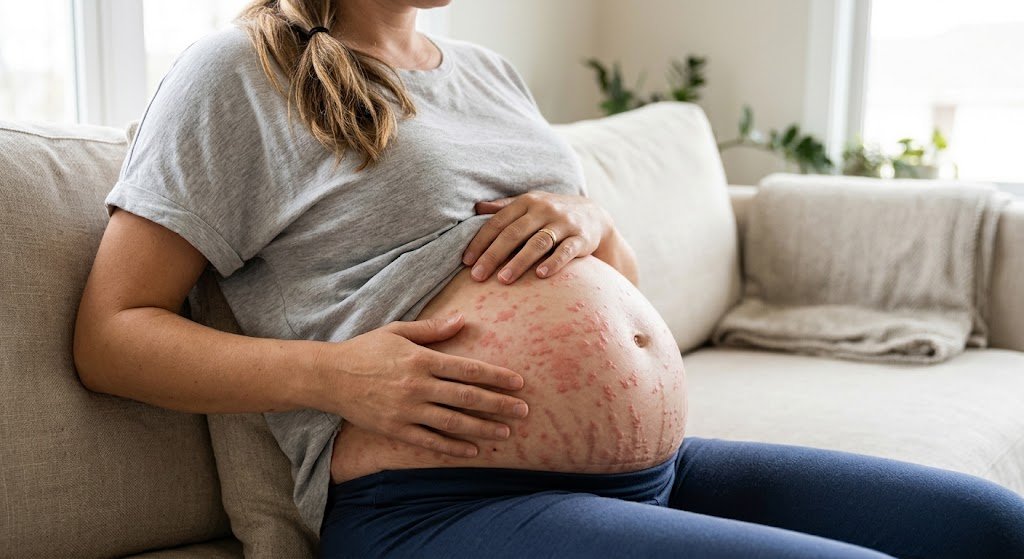
Pregnancy brings many changes to your body, including changes to your skin. While some skin changes are completely normal, developing an intensely itchy rash during pregnancy can be uncomfortable and worrying.
One possible cause is PUPPP rash, a pregnancy-related skin condition that usually develops during the third trimester. Although the itching can be severe, PUPPP is generally harmless to both the mother and baby and usually disappears after delivery.
In this guide, we’ll explain what PUPPP rash is, how to recognize its symptoms, what causes it, and which treatments may help relieve itching during pregnancy.
What Is PUPPP Rash During Pregnancy?
PUPPP stands for Pruritic Urticarial Papules and Plaques of Pregnancy. It is a skin condition characterized by itchy, raised bumps that may join together to form larger, hive-like patches.
PUPPP is also known as polymorphic eruption of pregnancy (PEP), which is the preferred term in some medical references.
The rash typically begins on the abdomen, particularly within stretch marks, and may spread to the thighs, buttocks, and other areas of the body.
PUPPP most often develops during the third trimester, especially in the final weeks of pregnancy. Occasionally, it can appear shortly after delivery.
Although PUPPP can cause significant discomfort, it generally does not harm the developing baby and usually resolves on its own after childbirth.
What Does PUPPP Rash Look Like?
PUPPP rash can look similar to hives or an allergic skin reaction. Its appearance may vary depending on your skin tone and how the condition progresses.
Common features include:
- Small, raised, itchy bumps that may merge into larger patches.
- Pink or red areas on lighter skin, or skin-colored, darker, or otherwise discolored patches on darker skin.
- A rash that begins within abdominal stretch marks.
- Extension to the thighs, buttocks, or occasionally the arms and other areas.
- Intense itching that may interfere with sleep and daily activities.
One characteristic feature is that the area immediately surrounding the belly button is often spared, although individual presentations can vary.
PUPPP does not usually affect the face, palms, or soles.
Important: Not every itchy rash during pregnancy is PUPPP. Blisters, unusual rash patterns, or itching without a typical rash require medical assessment to exclude other conditions.
What Causes PUPPP Rash During Pregnancy?
The exact cause of PUPPP remains unknown. However, researchers have proposed several possible explanations.
- Skin stretching
One leading theory is that rapid stretching of the abdominal skin during pregnancy may contribute to inflammation around the connective tissue. This may help explain why the rash often begins within stretch marks.
- Pregnancy-related changes
Hormonal and immune system changes during pregnancy may also contribute to the development of PUPPP, although the precise mechanisms are not fully understood.
- Factors associated with a higher risk
PUPPP is more commonly reported in women who are experiencing their first pregnancy or carrying twins or triplets.
It typically develops during late pregnancy, when abdominal skin stretching is greatest.
These associations do not mean that a woman with these characteristics will necessarily develop the rash.
When Does PUPPP Rash Start?
PUPPP most commonly appears during the third trimester, particularly during the last few weeks of pregnancy.
In some cases, the rash develops shortly after childbirth.
The duration varies, but many women notice improvement after delivery, with symptoms typically resolving within a few weeks. Some cases may take longer to clear.
If itching begins early in pregnancy, or the rash does not follow the typical pattern, a healthcare professional should evaluate other possible causes.
Is PUPPP Rash Dangerous for the Baby?
PUPPP is generally considered a benign pregnancy-related skin condition. It is not usually associated with harm to the baby, and the rash itself is not normally a reason to induce labor or perform a cesarean delivery.
However, it is important to obtain an accurate diagnosis rather than assuming that every pregnancy rash is PUPPP.
Other conditions, including intrahepatic cholestasis of pregnancy and pemphigoid gestationis, can also cause itching but require different evaluation and management.
Contact your obstetrician promptly if you develop significant itching, especially if it affects your palms or soles or occurs without an obvious rash.
How Is PUPPP Rash Diagnosed?
A healthcare professional can usually diagnose PUPPP by examining the rash and reviewing your symptoms and pregnancy history.
The clinician will consider:
- When the itching and rash began.
- Where the rash first appeared and how it has spread.
- Whether there are blisters or other unusual skin changes.
- Whether you have symptoms that suggest another pregnancy-related condition.
There is no single routine test that confirms every case of PUPPP. If the diagnosis is uncertain, your clinician may recommend blood tests or, occasionally, a skin biopsy to rule out other conditions.
For example, liver function tests and bile acid measurements may be appropriate when intrahepatic cholestasis of pregnancy is suspected.
How to Treat PUPPP Rash During Pregnancy
There is no specific treatment that immediately eliminates PUPPP. Treatment focuses on reducing inflammation and relieving itching until the rash resolves.
- Use cool compresses
Apply a clean, cool, damp cloth to itchy areas for short periods. Cool showers or baths may also help soothe irritated skin.
Avoid very hot water because it can worsen itching.
- Apply a fragrance-free moisturizer
A gentle, fragrance-free moisturizer or emollient may help soothe the skin and reduce dryness.
Choose products designed for sensitive skin and discontinue any product that causes irritation.
- Wear loose, breathable clothing
Lightweight cotton clothing can reduce friction and help keep your skin cool.
Tight clothing and excessive heat may aggravate discomfort.
- Ask about anti-itch medications
If home remedies are not enough, your healthcare professional may recommend an appropriate topical corticosteroid or an oral antihistamine.
The choice of medication depends on the severity of your symptoms, your stage of pregnancy, and your medical history.
Do not start a medicated cream, antihistamine, or oral steroid without checking with your obstetrician or another qualified healthcare professional.
- Seek help if itching affects your sleep
Severe itching can interfere with sleep and quality of life. Your clinician may consider additional treatment if symptoms are persistent or particularly uncomfortable.
The goal is to control symptoms safely while monitoring for conditions that may resemble PUPPP.
PUPPP Rash vs. Other Pregnancy Skin Conditions
Several conditions can cause itching during pregnancy, but their symptoms and risks differ.
| Condition | Typical features | Important distinction |
|---|---|---|
| PUPPP rash | Itchy bumps that often begin in abdominal stretch marks | Usually benign and resolves after delivery |
| Intrahepatic cholestasis of pregnancy | Often intense itching without a primary rash, particularly on palms and soles | Requires prompt medical assessment and bile acid testing |
| Pemphigoid gestationis | Itchy rash that may involve the belly button and develop into blisters | Requires specialist assessment because management differs |
| Eczema | Dry, inflamed, itchy patches that may occur in several body areas | May be associated with a history of eczema or sensitive skin |
Because these conditions can overlap in appearance or symptoms, a healthcare professional should assess a new or persistent pregnancy-related rash.
Does PUPPP Rash Go Away After Delivery?
Yes. PUPPP usually improves after childbirth and often resolves within a few weeks.
The exact timeline varies from person to person. During recovery, gentle skin care and clinician-approved treatments can help control itching.
PUPPP generally does not leave permanent scars, although temporary skin changes may occur if the skin becomes irritated or injured from scratching.
The condition also tends not to recur in subsequent pregnancies, although recurrence is possible.
Can PUPPP rash start before the third trimester?
It most commonly develops during the third trimester, but unusual presentations can occur. A rash that begins earlier in pregnancy should be evaluated to determine its cause.
Is PUPPP rash contagious?
No. PUPPP is not an infectious condition and cannot be passed from one person to another through ordinary contact.
Can PUPPP rash spread across the body?
Yes. It commonly begins on the abdomen and can spread to the thighs, buttocks, and sometimes the arms or other areas.
Can I use hydrocortisone cream for PUPPP during pregnancy?
A healthcare professional may recommend an appropriate topical corticosteroid, including hydrocortisone in some cases. Check with your clinician before using it, because the suitable product and treatment duration depend on your individual circumstances.
How can I stop PUPPP itching at night?
Try a cool compress, a cool shower, a fragrance-free moisturizer, and loose cotton sleepwear. If itching continues to disrupt your sleep, ask your healthcare professional about pregnancy-appropriate treatment.
Does PUPPP mean something is wrong with my pregnancy?
Not usually. PUPPP is generally harmless to the baby. However, a medical assessment is important because other causes of itching during pregnancy may need different treatment or monitoring.
Final Thoughts
PUPPP rash during pregnancy can cause intense itching and considerable discomfort, particularly in the final weeks before delivery. Fortunately, it is generally a temporary condition that improves after childbirth.
Cool compresses, gentle skin care, and clinician-approved medications can help relieve symptoms. Most importantly, seek medical advice for a new pregnancy rash or persistent itching so that other conditions can be ruled out.
references
1- https://my.clevelandclinic.org/health/diseases/22374-puppp-rash
2- https://www.bad.org.uk/pils/polymorphic-eruption-of-pregnancy