
Noticing light bleeding before your expected period can be confusing, especially if you are trying to conceive. You may wonder whether it is the start of your menstrual cycle or an early sign of pregnancy.
Implantation bleeding is often described as light spotting that may occur in early pregnancy. However, its timing and appearance can overlap with those of a light period, and bleeding alone cannot confirm that implantation has occurred.
So, how can you tell implantation bleeding vs. a period? In this guide, we will compare their timing, color, flow, duration, and associated symptoms, explain when to take a pregnancy test, and discuss when bleeding requires medical attention.
What Is Implantation Bleeding?
Implantation refers to the process in which a fertilized egg attaches to the lining of the uterus during early pregnancy.
The term implantation bleeding is commonly used to describe light spotting that occurs around the time implantation may take place. It is often described as pink or brown and lighter than a typical menstrual period.
However, an important distinction is that implantation bleeding has not been firmly established as a distinct, reliably identifiable medical phenomenon. Research does not support using the appearance of spotting to determine whether implantation has occurred.
If you notice light bleeding around the time your period is due, pregnancy is one possible explanation, but hormonal fluctuations and other causes of spotting are also possible.
Implantation Bleeding vs. Period: 7 Key Differences
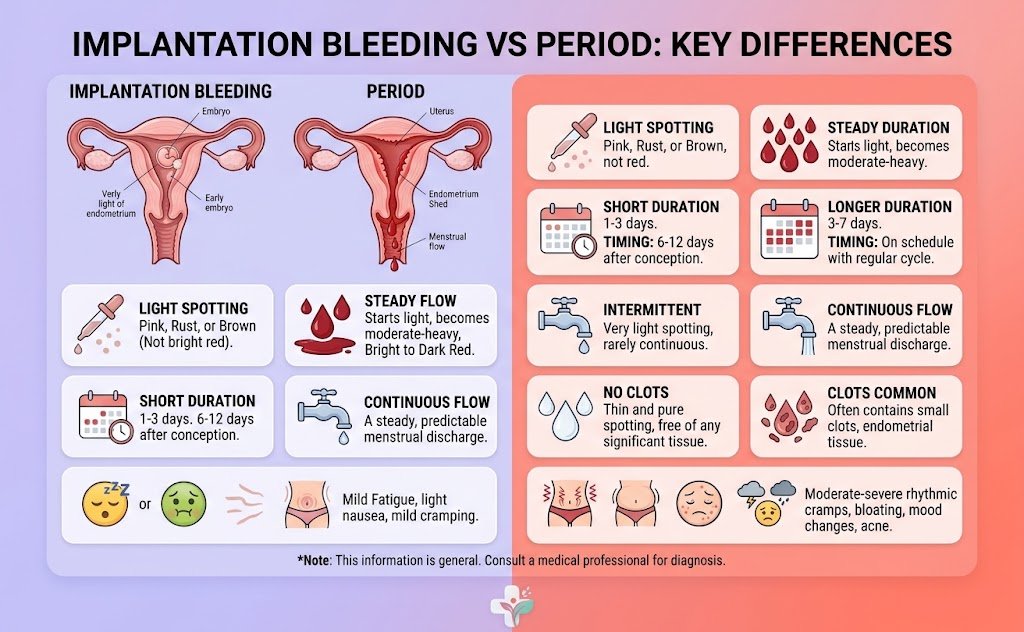
Although there is no definitive way to distinguish implantation bleeding from a period based on appearance alone, the following features may help you understand the differences.
- Timing
Implantation-related spotting: If it occurs, it may appear around the time your period is expected, often roughly 6–12 days after ovulation in descriptions of early pregnancy.
Menstrual period: A period generally begins around the end of your menstrual cycle, following a drop in estrogen and progesterone when pregnancy has not occurred.
Because these time frames can overlap, timing alone cannot tell you whether you are pregnant.
- Color
Implantation bleeding: Spotting is often described as light pink, brown, or occasionally red.
Menstrual period: Menstrual blood may appear bright red, dark red, or brown, depending on the flow and how long the blood has been present.
Color is not a reliable diagnostic sign. Both early pregnancy spotting and menstrual bleeding can vary in color.
- Flow and Amount
Implantation bleeding: Typically described as very light spotting, such as a few spots of blood on underwear or toilet paper.
Menstrual period: Usually develops into a more established flow that may require a pad, tampon, or menstrual cup.
If bleeding becomes progressively heavier, resembles your usual menstrual flow, or includes clots, it may be more consistent with a period. However, bleeding patterns vary, and heavier bleeding does not automatically rule out pregnancy.
- Duration
Implantation bleeding: Descriptions often refer to brief spotting lasting a few hours to a day or two, but there is no established duration that confirms implantation.
Menstrual period: Commonly lasts around 2–7 days, although individual menstrual patterns differ.
Bleeding that lasts only one day does not necessarily mean implantation occurred. Similarly, a period can be lighter or shorter than usual.
- Cramps
Implantation bleeding: Some people report mild cramping around the time of early pregnancy spotting, but cramping is not a proven sign of implantation.
Menstrual period: Cramps are common and may range from mild discomfort to more significant pain as the uterus contracts.
Cramping can occur for several reasons, including an approaching period and early pregnancy. Its severity or location cannot reliably distinguish between the two.
- Associated Symptoms
Possible early pregnancy symptoms: Some people experience breast tenderness, fatigue, nausea, or increased urination. Others have no noticeable symptoms in the earliest weeks.
Premenstrual symptoms: Breast tenderness, bloating, mood changes, fatigue, and cramps may occur before menstruation.
Many symptoms overlap because both the menstrual cycle and early pregnancy involve hormonal changes. Symptoms alone cannot confirm pregnancy.
- What Happens Next?
This is often the most useful difference to observe.
If the bleeding is the beginning of your period, it will generally follow your usual menstrual pattern, although the amount and duration can vary.
If you are pregnant, your period will usually not occur. However, some pregnant people experience spotting or other bleeding.
A pregnancy test is a more reliable way to distinguish pregnancy from an approaching period than trying to interpret the bleeding itself.
Implantation Bleeding vs. Period: Comparison Table
| Feature | Possible implantation-related spotting | Menstrual period |
|---|---|---|
| Timing | May occur around the expected period | Usually occurs at the end of the menstrual cycle |
| Color | Often described as pink or brown | Can be pink, red, dark red, or brown |
| Flow | Usually described as light spotting | Typically develops into menstrual flow |
| Duration | Often described as brief | Commonly 2–7 days |
| Clots | Usually not expected with very light spotting | May occur, particularly with heavier flow |
| Cramps | May be absent or mild | Common, with variable intensity |
| Pregnancy confirmation | Bleeding cannot confirm pregnancy | A typical period generally suggests pregnancy has not occurred, but bleeding alone is not conclusive |
Remember: These are general patterns, not diagnostic rules. Early pregnancy bleeding can resemble menstrual bleeding, and unusual menstrual bleeding can resemble spotting.
Can Implantation Bleeding Be Heavy?
Bleeding commonly described as implantation bleeding is usually light. Bleeding that soaks pads, contains substantial clots, or is accompanied by significant pain should not automatically be attributed to implantation.
Possible causes of bleeding in early pregnancy include cervical changes, infection, early pregnancy loss, and ectopic pregnancy.
If you have a positive pregnancy test and experience bleeding, contact your healthcare professional for advice. Seek urgent medical attention if the bleeding is heavy or you have severe abdominal pain, shoulder-tip pain, dizziness, or fainting.
These symptoms can indicate a serious problem and should not be ignored.
When Should You Take a Pregnancy Test?
If you are trying to conceive, it can be tempting to take a pregnancy test as soon as you notice spotting. However, testing too early may produce a false-negative result because human chorionic gonadotropin (hCG) levels may still be too low to detect.
For the most reliable result:
- If your period is due: Take a home pregnancy test on or after the first day of your missed period.
- If you do not know when your period is due: Test at least 21 days after your last unprotected sexual intercourse.
- If the result is negative but your period does not start: Repeat the test after a few days.
- If the test is positive and you have bleeding: Contact your healthcare professional for guidance.
Follow the test instructions carefully. A negative result obtained too early does not completely rule out pregnancy.
Other Causes of Spotting Before Your Period
Not all bleeding before a period is related to implantation or pregnancy. Other possible causes include:
- Hormonal fluctuations
Changes in estrogen and progesterone can affect the uterine lining and sometimes cause spotting between periods.
- Ovulation spotting
Some people experience light spotting around ovulation, which generally occurs earlier in the menstrual cycle than the expected period.
- Hormonal contraception
Starting, stopping, or missing hormonal contraceptives can lead to irregular bleeding or spotting.
- Cervical irritation
Sexual intercourse, cervical inflammation, or certain cervical conditions may cause bleeding.
- Early pregnancy complications
Bleeding can occur during an early pregnancy loss or an ectopic pregnancy. These conditions require appropriate medical assessment, particularly when pain or other warning symptoms are present.
Persistent or recurrent spotting should be discussed with a healthcare professional to identify the cause.
When Should You See a Doctor?
Seek medical advice if you experience unexplained bleeding between periods, recurrent spotting, or bleeding when you may be pregnant.
Seek urgent medical attention if you experience:
- Heavy bleeding, especially if you are soaking pads rapidly.
- Severe or worsening abdominal or pelvic pain.
- Pain concentrated on one side of your lower abdomen.
- Shoulder-tip pain, dizziness, weakness, or fainting.
- Bleeding accompanied by significant pain when pregnancy is possible, even if you have not yet received a positive pregnancy test.
These symptoms can indicate an ectopic pregnancy or another condition requiring urgent care.
Frequently Asked Questions
How can I tell implantation bleeding from my period?
Implantation bleeding is commonly described as light, brief spotting, while a period usually develops into a more sustained menstrual flow. However, their timing, color, and duration overlap, so a pregnancy test is the best way to check for pregnancy.
Can implantation bleeding look like a normal period?
Bleeding in early pregnancy can sometimes resemble a period. It is not possible to confirm implantation based on the appearance of blood alone. If you experience bleeding that is unusual for you, consider taking a pregnancy test and seeking medical advice when appropriate.
Can you have implantation bleeding without cramps?
Yes, early pregnancy spotting may occur without cramps. However, the presence or absence of cramping cannot establish whether implantation has occurred.
Does implantation bleeding happen before a missed period?
Spotting attributed to implantation is often described as occurring around the time a period is expected. However, spotting before a missed period has many possible causes and does not reliably predict pregnancy.
Can you take a pregnancy test while spotting?
Yes. Spotting does not prevent a home pregnancy test from working. However, testing too early may produce a false-negative result. Testing on or after the first day of a missed period is generally more reliable.
Does brown blood mean implantation bleeding?
No. Brown blood usually indicates that blood has taken longer to leave the body and has oxidized. It can occur before, during, or after a period and does not confirm pregnancy.
Can you be pregnant and still have bleeding around your period date?
Yes. Some people experience bleeding during early pregnancy. However, bleeding during pregnancy should not automatically be assumed to be implantation bleeding, particularly if it is heavy, persistent, painful, or accompanied by other symptoms.
Final Thoughts
Understanding implantation bleeding vs. a period can help you decide what to do when unexpected spotting occurs, but the differences are not always clear.
Light spotting around your expected period may occur in early pregnancy, but it can also result from normal hormonal changes or other causes. Color, flow, duration, and cramping cannot reliably confirm implantation.
If pregnancy is possible, take a home pregnancy test at the appropriate time. If you experience severe pain, heavy bleeding, dizziness, or fainting, seek urgent medical care.
references
1- https://my.clevelandclinic.org/health/symptoms/24536-implantation-bleeding